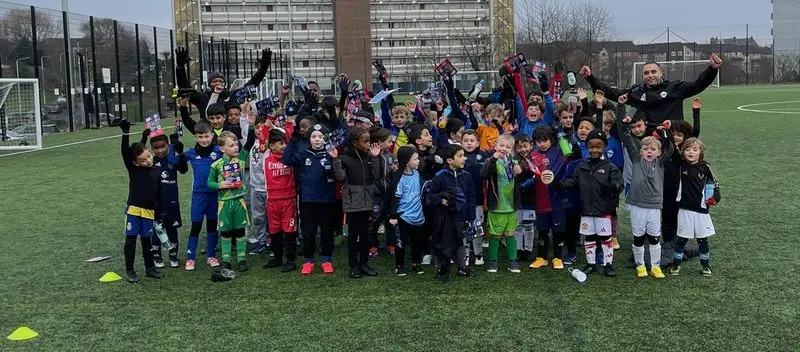
Five drills we use weekly at the Matico Fun Football Centres. Each one needs nothing more than a ball, a wall, a few cones (or shoes), and 10 minutes. Practise daily, the gains compound fast.
1. The 60-second touch challenge
Set a 60-second timer. Tap the ball alternately with the inside of each foot, left, right, left, right, without losing control. Count touches. Beat the previous day’s number. Goal: 90+ touches in 60 seconds for a 10-year-old, 110+ for a 13-year-old.
Why it works: trains the smaller stabilising muscles in the foot and ankle, and builds rhythm. The kids who can do this fluidly look completely different on the ball.
2. Wall pass with the weak foot
Stand 2 metres from a wall. Pass with the inside of the weak foot, control the rebound with the same foot, repeat. Two minutes. Then switch to the outside of the foot. Two minutes. Then the laces. Two minutes.
Why it works: the weak foot is the single biggest leverage point in young football development. Most players are 80% better with one foot than the other. Wall work fixes it faster than anything else.
3. The 4-cone box
Lay out four cones (or shoes) in a 1m square. Dribble in and out of the box: figure-of-eight, then sole rolls, then drag-backs. 30 seconds each pattern. Three rounds.
Why it works: tight-space ball control. The kids who can manipulate the ball in a phone-box-sized area are the kids who hold possession in matches.
4. Step-over to scissor
Place a cone (or trainer). Approach at a jog. Step over the ball with the right foot, push out with the left. Repeat the other way. Then double up: two step-overs, push out. Then a scissor move. Build slowly.
Why it works: moves only become useful in a match when they’re automatic. Repetition over time builds that.
5. The first-touch reset
Throw the ball gently against a wall so it returns at chest height. Take a first touch that drops the ball at your feet, ready to play forward. Repeat. Vary the throw, high, low, side. The first touch should set up the next move, more than just stop the ball.
Why it works: first touch separates good young players from the rest. A poor first touch invites pressure and forces a hurried decision. A clean first touch creates time.
Ten minutes a day, four days a week, beats one big session at the weekend.
How often, how long
Keep it short. Keep it consistent. Track touches. Compete against yesterday. Six weeks of daily 10-minute drills will outpace six months of weekend-only practice every time.
If your child takes one of these drills and makes it a habit, that’s the win. Skill is the compound interest of repetition.